
A Dislocated Shoulder at 18 and at 60 Are Two Different Injuries

Same joint, same painful moment, completely different problem. Your age when the shoulder comes out changes what tends to break, what tends to happen next, and what I look for first.
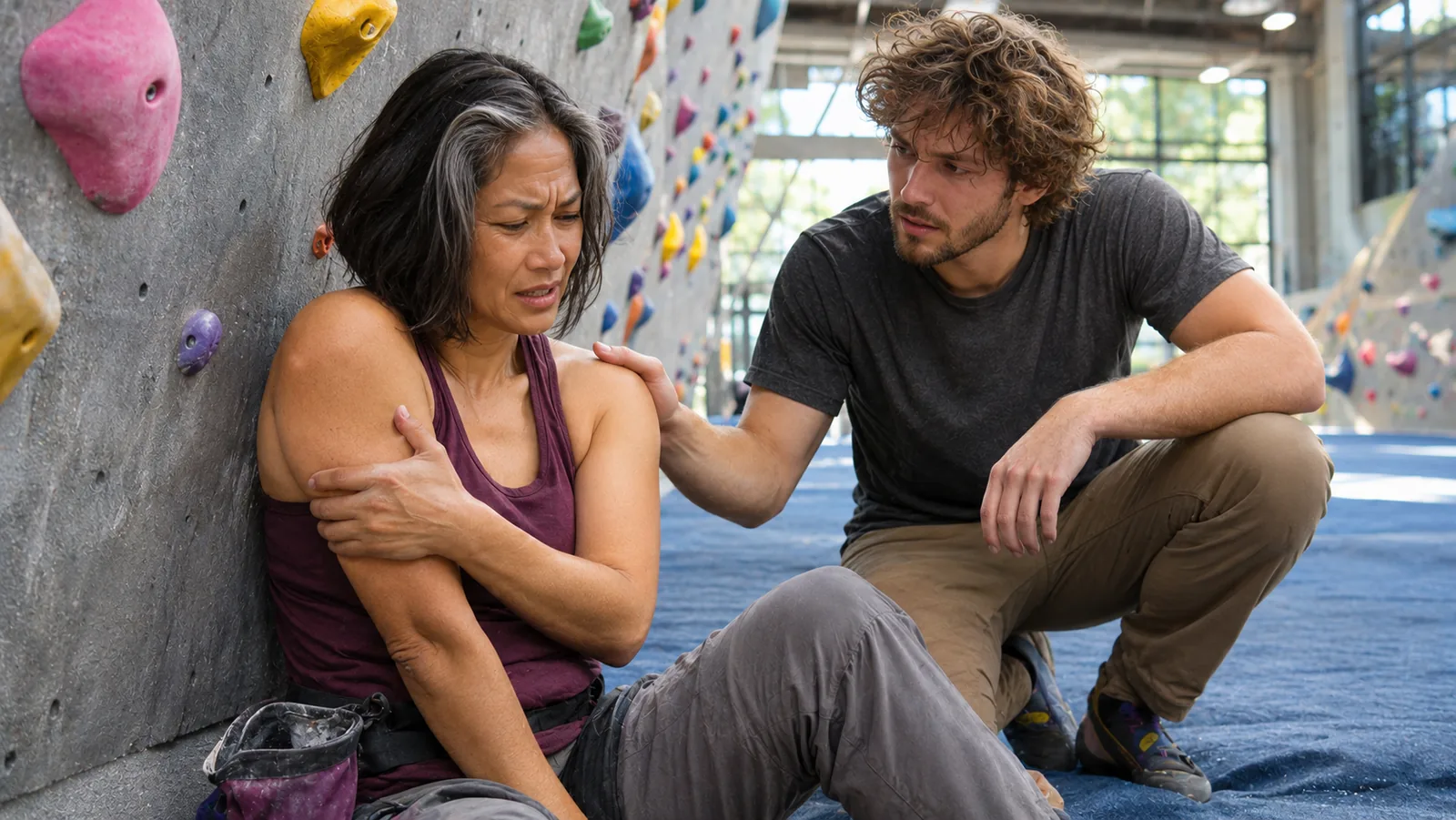
Woman at a climbing gym holding her injured shoulder against her body as her son kneels beside her
"It popped out, my buddy popped it back in, and I'm good now." I hear that all the time from young athletes. From patients in their sixties, I hear a quieter version: "It's back in, so it must be fine."

Both sentences make me nervous, for opposite reasons. That is the insight I want you to take from this article. When a shoulder dislocates in a teenager or young adult, the big risk is that it will happen again. When it dislocates in someone over forty, the shoulder usually stays in. The big risk is what was torn on the way out.

More than half

of people aged 15 to 35 had their shoulder become unstable again within two years of a first dislocation treated with a sling and therapy.

Why Young Shoulders Keep Coming Out

The shoulder is a ball sitting on a shallow socket, held in place by a ring of cartilage called the labrum and a sleeve of ligaments. When a young shoulder is forced out, usually forward, the labrum often tears off the front of the socket. That tear is called a Bankart lesion, and I wrote about it in detail in my volleyball article.

Young tissue is strong and elastic, but once the labrum is detached, the shoulder has lost one of its main restraints. Young men in contact and overhead sports carry the highest risk of it happening again. And every new dislocation can chip a little more bone from the socket, which can change the kind of surgery needed later.

Why Older Shoulders Tear Instead

After forty, the balance flips. Ligaments are stiffer and the rotator cuff tendons have had decades of wear, so the force of a dislocation is more likely to tear the cuff than the labrum. Older adults are also more likely to break a piece of bone or stretch a nerve when the shoulder comes out.

In one study of first time dislocations in people forty and older, only 4% dislocated again. But 35% turned out to have a rotator cuff tear, and those patients were far less likely to end up with a good result. A shoulder that is back in place but still cannot lift the arm after a couple of weeks is not "just sore." It needs a closer look.

Do Not Let Anyone Yank It Back In

I understand the instinct. It hurts, and a teammate or friend has seen it done on television. But a forced reduction without imaging can miss a fracture or make one worse, and it can injure the nerves and blood vessels near the joint. Support the arm against your body and get to an emergency room or urgent care. Imaging before and after the shoulder goes back in matters at every age.

The Kneecap Is Its Own Story

Kneecaps dislocate too, usually sliding out to the side during a twist or a sudden cut. The risk is highest in girls between 10 and 17. Many first time kneecap dislocations are treated without surgery, with bracing and focused strengthening of the hip and thigh. People who have already had the kneecap slip before are much more likely to have it happen again, and that is when we talk about stabilization.

What to Do After a Dislocation

  • Get imaging. Before and after the joint goes back in, at any age.
  • Do the rehab. Strength and control around the joint are your first line of defense.
  • Know your numbers. Young, active and in a contact or overhead sport? Ask about your risk of it happening again before you return.
  • Check your strength. Over forty and still weak lifting the arm after two weeks? Ask about your rotator cuff.
  • Do not wait for a second one. Each dislocation can do more damage than the last.

When You Do Need Us

Shoulder instability is at the center of my practice at TruOrtho in San Antonio, and the right plan depends on who you are. For a young athlete, that may be therapy or an arthroscopic stabilization to repair the labrum. For an older adult, it may be a rotator cuff repair, the surgery I describe in my pickleball article. For some patients with arthritis or a cuff that cannot be repaired, shoulder replacement becomes the conversation. You can read more about my shoulder work on my TruOrtho page.

If your shoulder or kneecap has come out, even once, let's make sure nothing was missed. Request an appointment with Dr. Lynch or call (210) 878-4116.

Questions About Dislocations

How long does a dislocated shoulder take to heal?
The first few weeks focus on calming pain and protecting the joint, then rehab rebuilds strength over the following months. Return to contact or overhead sports takes longer and should be based on strength and stability, not the calendar.

How many times can you dislocate your shoulder before you need surgery?
There is no magic number. For young athletes in contact or overhead sports, stabilization is often discussed after the first dislocation, because each one can cause more damage to bone and cartilage.

Should older adults get an MRI after a dislocation?
If you are over forty and still struggle to lift your arm a couple of weeks after a dislocation, yes, an MRI or ultrasound to check the rotator cuff is worth discussing.

Sources

Robinson CM, Howes J, Murdoch H, Will E, Graham C. Functional outcome and risk of recurrent instability after primary traumatic anterior shoulder dislocation in young patients. J Bone Joint Surg Am. 2006;88(11):2326-2336.
Pevny T, Hunter RE, Freeman JR. Primary traumatic anterior shoulder dislocation in patients 40 years of age and older. Arthroscopy. 1998;14(3):289-294.
Fithian DC, Paxton EW, Stone ML, et al. Epidemiology and natural history of acute patellar dislocation. Am J Sports Med. 2004;32(5):1114-1121.


Recent Posts

See All

A Dislocated Shoulder at 18 and at 60 Are Two Different Injuries

Same joint, same painful moment, completely different problem. Your age when the shoulder comes out changes what tends to break, what tends to happen next, and what I look for first.

Woman at a climbing gym holding her injured shoulder against her body as her son kneels beside her
"It popped out, my buddy popped it back in, and I'm good now." I hear that all the time from young athletes. From patients in their sixties, I hear a quieter version: "It's back in, so it must be fine."

Both sentences make me nervous, for opposite reasons. That is the insight I want you to take from this article. When a shoulder dislocates in a teenager or young adult, the big risk is that it will happen again. When it dislocates in someone over forty, the shoulder usually stays in. The big risk is what was torn on the way out.

More than half

of people aged 15 to 35 had their shoulder become unstable again within two years of a first dislocation treated with a sling and therapy.

Why Young Shoulders Keep Coming Out

The shoulder is a ball sitting on a shallow socket, held in place by a ring of cartilage called the labrum and a sleeve of ligaments. When a young shoulder is forced out, usually forward, the labrum often tears off the front of the socket. That tear is called a Bankart lesion, and I wrote about it in detail in my volleyball article.

Young tissue is strong and elastic, but once the labrum is detached, the shoulder has lost one of its main restraints. Young men in contact and overhead sports carry the highest risk of it happening again. And every new dislocation can chip a little more bone from the socket, which can change the kind of surgery needed later.

Why Older Shoulders Tear Instead

After forty, the balance flips. Ligaments are stiffer and the rotator cuff tendons have had decades of wear, so the force of a dislocation is more likely to tear the cuff than the labrum. Older adults are also more likely to break a piece of bone or stretch a nerve when the shoulder comes out.

In one study of first time dislocations in people forty and older, only 4% dislocated again. But 35% turned out to have a rotator cuff tear, and those patients were far less likely to end up with a good result. A shoulder that is back in place but still cannot lift the arm after a couple of weeks is not "just sore." It needs a closer look.

Do Not Let Anyone Yank It Back In

I understand the instinct. It hurts, and a teammate or friend has seen it done on television. But a forced reduction without imaging can miss a fracture or make one worse, and it can injure the nerves and blood vessels near the joint. Support the arm against your body and get to an emergency room or urgent care. Imaging before and after the shoulder goes back in matters at every age.

The Kneecap Is Its Own Story

Kneecaps dislocate too, usually sliding out to the side during a twist or a sudden cut. The risk is highest in girls between 10 and 17. Many first time kneecap dislocations are treated without surgery, with bracing and focused strengthening of the hip and thigh. People who have already had the kneecap slip before are much more likely to have it happen again, and that is when we talk about stabilization.

What to Do After a Dislocation

  • Get imaging. Before and after the joint goes back in, at any age.
  • Do the rehab. Strength and control around the joint are your first line of defense.
  • Know your numbers. Young, active and in a contact or overhead sport? Ask about your risk of it happening again before you return.
  • Check your strength. Over forty and still weak lifting the arm after two weeks? Ask about your rotator cuff.
  • Do not wait for a second one. Each dislocation can do more damage than the last.

When You Do Need Us

Shoulder instability is at the center of my practice at TruOrtho in San Antonio, and the right plan depends on who you are. For a young athlete, that may be therapy or an arthroscopic stabilization to repair the labrum. For an older adult, it may be a rotator cuff repair, the surgery I describe in my pickleball article. For some patients with arthritis or a cuff that cannot be repaired, shoulder replacement becomes the conversation. You can read more about my shoulder work on my TruOrtho page.

If your shoulder or kneecap has come out, even once, let's make sure nothing was missed. Request an appointment with Dr. Lynch or call (210) 878-4116.

Questions About Dislocations

How long does a dislocated shoulder take to heal?
The first few weeks focus on calming pain and protecting the joint, then rehab rebuilds strength over the following months. Return to contact or overhead sports takes longer and should be based on strength and stability, not the calendar.

How many times can you dislocate your shoulder before you need surgery?
There is no magic number. For young athletes in contact or overhead sports, stabilization is often discussed after the first dislocation, because each one can cause more damage to bone and cartilage.

Should older adults get an MRI after a dislocation?
If you are over forty and still struggle to lift your arm a couple of weeks after a dislocation, yes, an MRI or ultrasound to check the rotator cuff is worth discussing.

Sources

Robinson CM, Howes J, Murdoch H, Will E, Graham C. Functional outcome and risk of recurrent instability after primary traumatic anterior shoulder dislocation in young patients. J Bone Joint Surg Am. 2006;88(11):2326-2336.
Pevny T, Hunter RE, Freeman JR. Primary traumatic anterior shoulder dislocation in patients 40 years of age and older. Arthroscopy. 1998;14(3):289-294.
Fithian DC, Paxton EW, Stone ML, et al. Epidemiology and natural history of acute patellar dislocation. Am J Sports Med. 2004;32(5):1114-1121.
Recent Posts

See All