In Basketball, Your ACL Tears When Nobody Is Near You
An ACL tear in basketball rarely looks like a collision. It looks like an ordinary rebound, a quick stop or a hard cut. That is frustrating, and it is also the best news in this article, because what happens without contact can be trained.
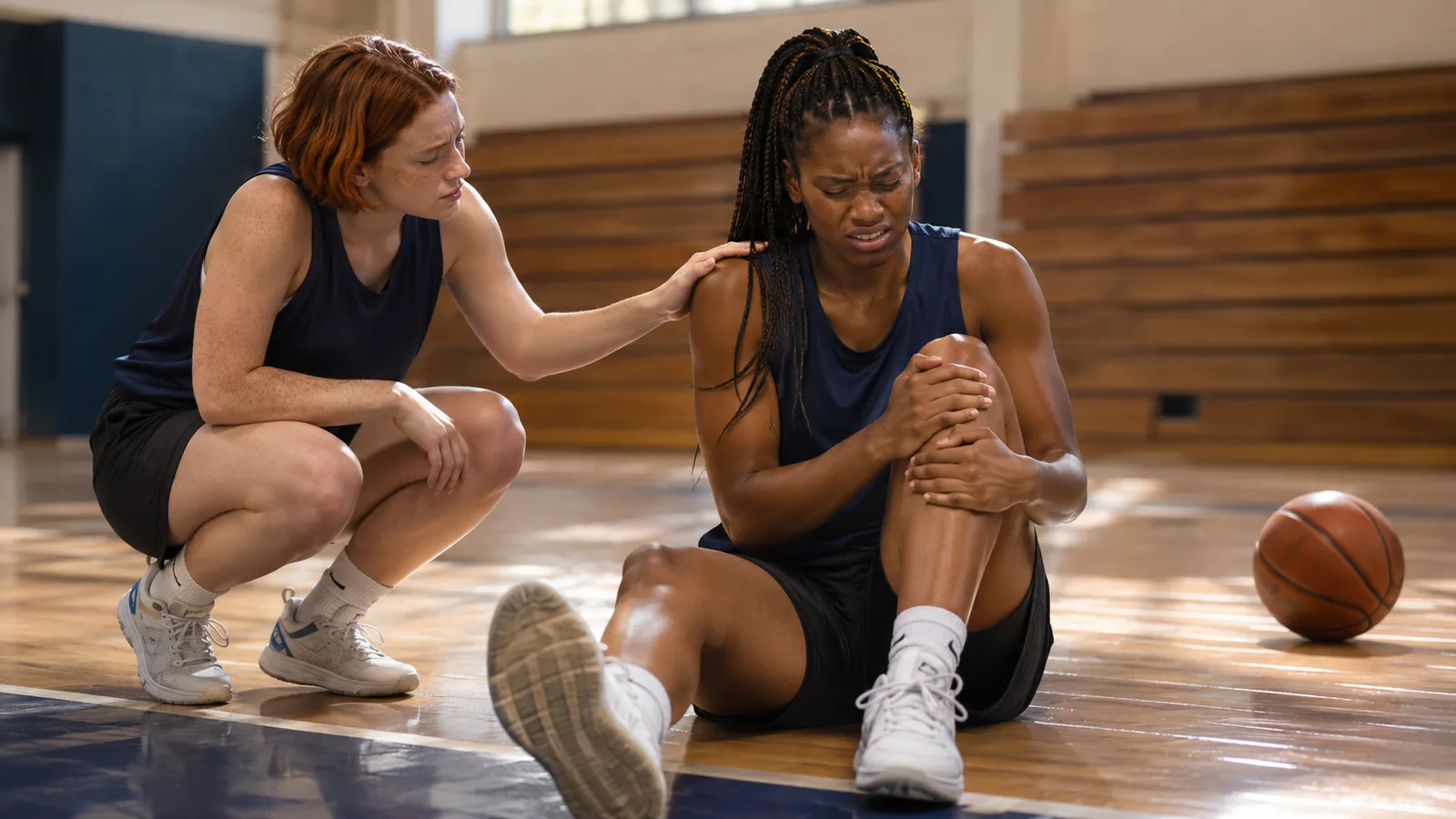
"Nobody even touched me. I came down from a rebound and my knee just went." I hear some version of that sentence after almost every basketball ACL tear I treat, and the surprise in it never changes.
Most people picture a torn ACL as the result of a hit: a collision under the basket, a player falling into your leg. In basketball it rarely works that way. The ligament usually gives out during a move the athlete has made ten thousand times before, landing from a rebound, planting to change direction or stopping short on a closeout.
That is the part I want every player, parent and coach to hear. If the injury does not need contact, then prevention does not depend on luck. It depends on how you land, how you cut and how strong the muscles around your knee are when you are tired.
3 in 4
ACL tears in women's college basketball happened with no contact at all. In the men's game, the number was about 70%.
The same national college data showed women's basketball players tearing their ACL at more than three times the rate of the men. Anatomy and hormones play a part. So do movement patterns, and those are the piece we can change.
What Actually Happens in the Knee
Your anterior cruciate ligament, the ACL, is a short, strong band in the center of the knee. It keeps the shinbone from sliding forward and twisting under the thighbone. It handles enormous loads every game, until the knee lands in the wrong position with too much force behind it.
The classic picture is easy to recognize once you know it: foot planted, knee caving inward, body twisting over a nearly straight leg. Players often feel or hear a pop. The knee swells within a few hours, and it feels loose, as if it could give way on the next step.
The Moves That Put Your ACL at Risk
- Landing stiff. Coming down from a rebound or a block with straight knees and your weight back on your heels.
- Knees caving in. When the knee drops inward on a landing or a cut, the ACL takes load it was never meant to carry.
- Cutting at full speed off one leg. Especially when a defender forces a sudden change you did not plan.
- Fatigue. The fourth quarter and the third game of a tournament Saturday are where form quietly falls apart.
Not Every Knee Pain Is an ACL
The other knee problem I see constantly in basketball players is jumper's knee, or patellar tendinopathy. It is pain just below the kneecap that builds over weeks and flares with jumping, squatting and stairs. It is an overuse problem, not a tear, and most of it responds well to smarter loading and targeted strengthening.
The difference is worth knowing. Jumper's knee nags and often loosens up as you warm up. A torn ACL announces itself in a single moment, and the knee does not feel trustworthy afterward.
When a Knee Needs a Real Exam
- A pop at the moment of injury, followed by swelling within a few hours
- A knee that buckles, shifts or feels loose when you pivot
- Locking or catching, which can mean a meniscus tear came along with the ACL
- Pain under the kneecap that has lasted more than a few weeks or stops you from jumping
One warning: many people can walk the same day they tear their ACL. Walking is not the test. Cutting and pivoting are, and you should not try them on a knee that just popped.
How to Protect Your Knees
A basketball ACL prevention program is not exotic. The best ones are a structured warm-up that teaches landing, cutting and balance, done consistently all season rather than for two weeks in the fall. Soccer has the best-studied version, and I walk through it in my article on the 20 minute warm-up.
Land soft and quiet. Bend at the hips and knees, land on the balls of your feet, and keep your knees over your toes instead of collapsing inward. If your landings are loud, they are stiff.
Build the back of your legs. Strong hamstrings and glutes help keep the shinbone from sliding forward. Most players' training leans heavily on the quads.
Practice the stop, not just the sprint. Slowing down and changing direction are skills. Rehearse them in warm-ups at game speed.
Respect the fourth quarter. Conditioning is injury prevention. A tired athlete lands like an untrained one.
When You Do Need Us
ACL reconstruction is a big part of my practice at TruOrtho in San Antonio, and surgery is only one piece of the plan. It starts with a careful exam and imaging, then an honest conversation about your sport, your season and your goals. For many athletes who want to get back to cutting and jumping, reconstruction is the right call. Either way, the rehab afterward matters as much as the operation. You can read more about my training and approach on my TruOrtho page.
If your knee gave way on the court, do not wait to see whether it settles down. Request an appointment with Dr. Lynch or call (210) 878-4116.
Questions I Hear About Basketball Knees
Can you still play basketball with a torn ACL?
Some people can jog or shoot around, but cutting and landing on a knee without a working ACL risks more damage, especially to the meniscus and cartilage. Get it examined before you test it in a game.
Why do women tear their ACL more often than men?
It is a mix of factors working together: landing mechanics, the balance of strength between the front and back of the leg, anatomy and hormones. Landing and strength are the parts a good training program can change.
Does a knee brace prevent ACL tears in basketball?
A brace can help some athletes feel more stable, particularly after an injury, but it does not replace strength and good landing technique. How you move protects you more than anything you wear.
Sources
Agel J, Arendt EA, Bershadsky B. Anterior cruciate ligament injury in National Collegiate Athletic Association basketball and soccer: a 13-year review. Am J Sports Med. 2005;33(4):524-530.