The 20 Minute Warm-Up That Protects Soccer Knees
Soccer ACL injuries are among the most feared in youth and adult sports. The most effective protection is not a brace or a supplement. It is a free warm-up that most teams either skip or do halfway.
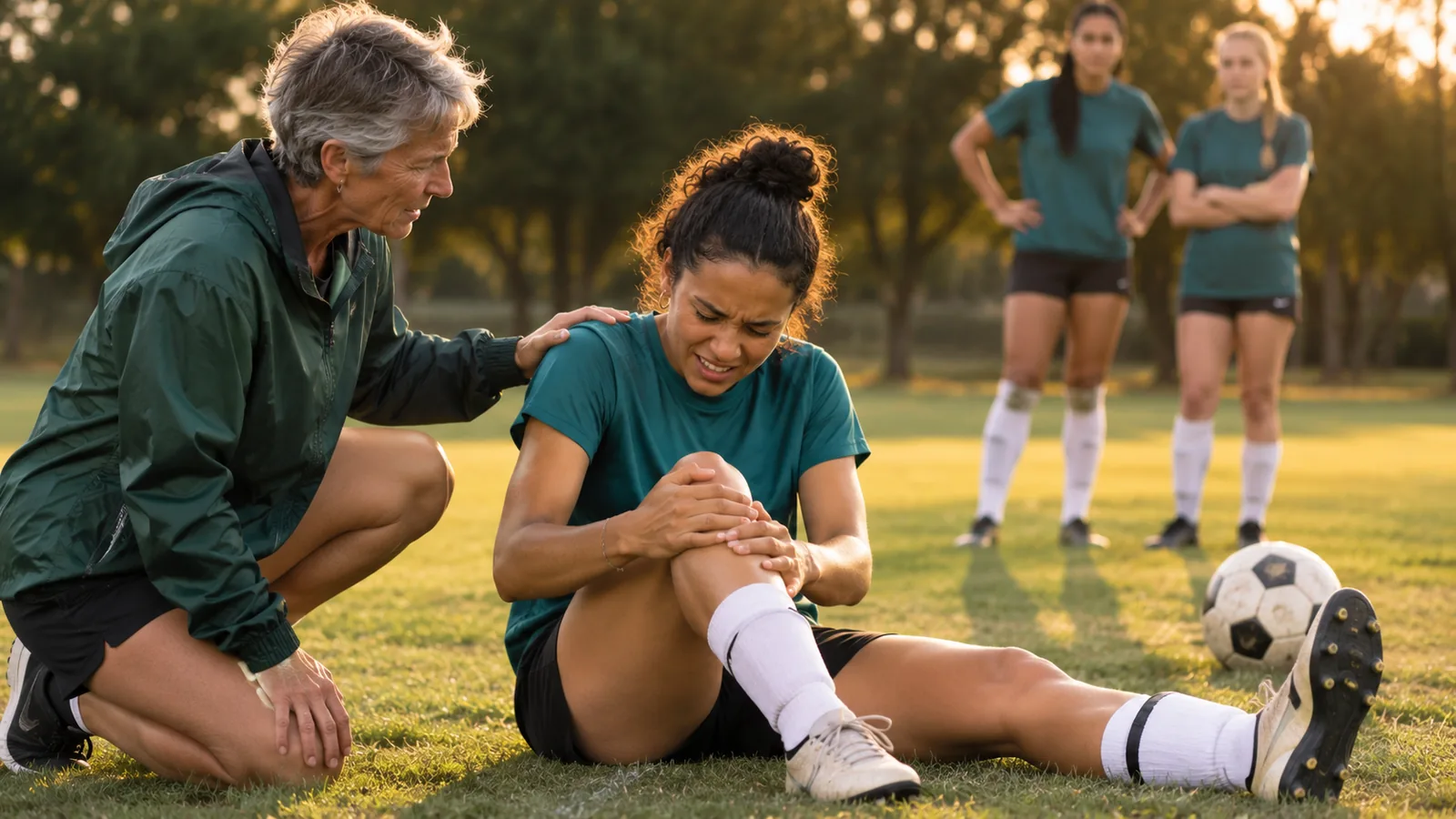
"Oh, we warm up. They jog a lap and stretch." I hear that from soccer parents and coaches all the time, and it is exactly the kind of warm-up that does nothing for an ACL.
Soccer asks the knee to do hard things over and over: sprint, slam on the brakes, plant and turn, land from a header, absorb a tackle from the side. The two structures that pay for it most often are the ACL, the ligament that keeps the knee from shifting and twisting, and the meniscus, the cushion between the thighbone and shinbone. In a bad landing or a hard pivot, they often tear together.
Here is the part that surprises families. Prevention for soccer knees has been studied in randomized trials, and one program stands out. It takes about twenty minutes, needs a few cones, and costs nothing.
30%
fewer injuries in soccer players who did the FIFA 11+ warm-up, across six randomized trials with more than 6,300 players.
What the FIFA 11+ Actually Is
The FIFA 11+ is a structured warm-up built by sports medicine researchers to replace the usual jog and stretch. It has 15 exercises in three parts:
- Running, about 8 minutes. Controlled jogging drills with hip openers, partner contact and quick changes of direction.
- Strength, plyometrics and balance, about 10 minutes. Planks, side planks, Nordic hamstring curls, single leg balance, squats and jumping, each with three levels of difficulty.
- Running, about 2 minutes. Faster runs with bounding and plant and cut movements.
Why does it work? Because it trains the exact things that protect an ACL: hamstrings strong enough to keep the shinbone from sliding forward, hips that stop the knee from caving inward, and landings that are soft and controlled instead of stiff. It turns good movement into a habit the body uses without thinking, even late in a game.
The program is meant to be done at least twice a week, before practice, all season long. Teams that stick with it get the benefit. Teams that try it for two weeks in August do not.
Why Girls Carry More of the Risk
In national college data, women's soccer players tore their ACL at three times the rate of men. Researchers point to several factors working together: landing with straighter knees, knees that cave inward on cuts, differences in hip and hamstring strength, anatomy and hormones.
The encouraging part is that the trainable pieces, landing, cutting and strength, are exactly what the middle section of the FIFA 11+ targets. If you coach or parent a girls' team, this is the single most useful twenty minutes of your week.
Where Most Teams Go Wrong
Skipping the hard part. The Nordic hamstring curls and single leg work are the least fun and the most important. Those are the first things teams drop.
Rushing the reps. A sloppy landing practiced twenty times teaches a sloppy landing. Coaches should watch knees, not the clock.
Stopping when the season gets busy. Injury risk does not take a break in tournament season, so the warm-up should not either.
Treating it as optional for good players. Skill does not protect an ACL. Strong, controlled movement does.
Leaving it to the players. Kids and even adults drift toward the easy version. Someone on the sideline has to own it, run it and correct it every time.
Signs of a Serious Knee Injury
- A pop, followed by swelling within a few hours
- A knee that gives way when you turn or change direction
- Locking, catching or being unable to fully straighten the knee
- Pain along the inside or outside joint line that keeps coming back
Locking deserves special attention. A knee that will not straighten can mean a torn piece of meniscus is caught in the joint, and that should be seen promptly.
When You Do Need Us
At TruOrtho in San Antonio, I care for soccer players of every age, from teenagers in club soccer to adults in weekend leagues. When the ACL tears, we talk through reconstruction and rehab based on your age, your goals and the level you want to return to. When the meniscus tears, saving it is often the priority, because that cushion protects the cartilage in your knee for the rest of your life. I explain that choice in my meniscus article. For more on how ACL tears happen without contact, see my article on basketball knees. You can read more about my approach on my TruOrtho page.
If your knee popped on the field, have it examined before the next game. Request an appointment with Dr. Lynch or call (210) 878-4116.
Questions Soccer Families Ask Me
Can you play soccer with a torn ACL?
Some players can run in a straight line, but cutting and pivoting on a knee without a working ACL risks further damage to the meniscus and cartilage. Get a proper exam before returning to any game.
Where can my team learn the FIFA 11+?
The full program, with videos of every exercise, is published free by FIFA. Ask your club's coaching director, or bring it to your team's athletic trainer or physical therapist to teach.
Do girls need a different program than boys?
No. The same program works for both, and the trials included male and female players. Girls simply have more to gain because their baseline ACL risk is higher.
Sources
Sadigursky D, Braid JA, De Lira DNL, et al. The FIFA 11+ injury prevention program for soccer players: a systematic review. BMC Sports Sci Med Rehabil. 2017;9:18.
Agel J, Arendt EA, Bershadsky B. Anterior cruciate ligament injury in National Collegiate Athletic Association basketball and soccer: a 13-year review. Am J Sports Med. 2005;33(4):524-530.